Need to do email segmentation on your email subscribers? In this article, we’re going to show you 7 ways businesses are using email segmentation to convert leads and generate revenue. Doing email segmentation the right way can unlock some incredible gains in your email campaigns.
In this article, we’re going to show you 7 ways businesses are using email segmentation to convert leads and generate revenue. Let’s take a look!
1.Email Segmentation by Demographic Data
Segmentation by demographic data is one of the original ways to segment consumers. Demographic data includes:
Age
Gender
Income
Education level
Religion
Ethnicity
If you’re targeting a specific niche, you should use more detailed segmentation options. However, demographic data is still indispensable if you’re covering different demographics, and it can be a great baseline.
How to Use Demographic Data for Email Segmentation
Demographic data can show you how to approach your customers.
For example, education level and age data can easily help you adopt the right tone of voice. You wouldn’t be formal with Gen Z’ers.
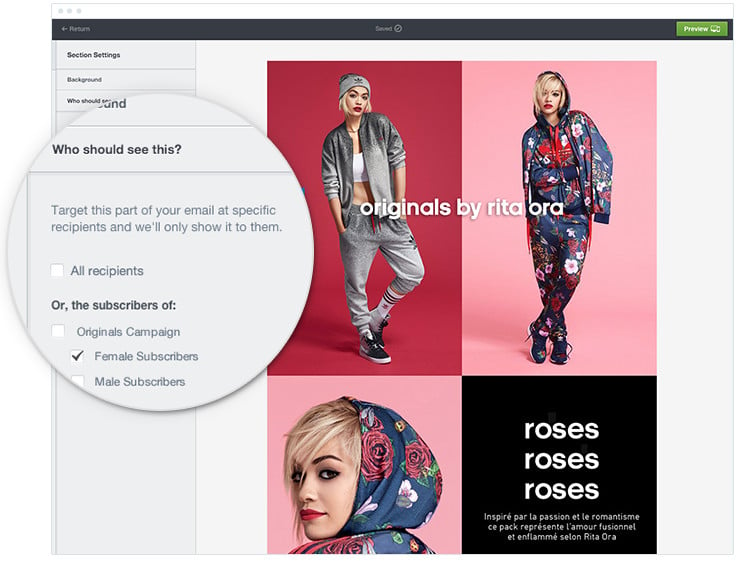
Similarly, you could notice that women love some of your products, while men prefer others.
This fashion brand distinguishes between their female and male followers and serves content accordingly.
This is really the simplest example, and even this goes far towards boosting your ROI.
2. Segment Emails by Behaviour
Email segmentation by behaviour (e.g. usage patterns, past purchases) is a great way to maximize the value of each customer you have. You can use this information to up-sell and cross-sell to them, as well. You can segment by:
Past purchases (value, product types, and categories, etc.)
Sign-up source
Engagement
Benefits and intent
And more!
Actions speak louder than words. And if you segment by actions your prospects take, you’ll be able to tailor offers and maximize your conversion rate.
How to Use Behaviour to Segment Email Audience
For example, if you sell perishables, you could set up refill emails. You could also do what Amazon did, and offer similar and complementary products based on past purchases.
You can also make sure that your email marketing matches the landing page offer.
For example, a lead may have subscribed to your list because they’re interested in a specific product category. If you take note of that, you can immediately follow-up and increase your conversion rate.
Strike while the iron is hot because first impressions matter.
Once your lead signs up, launch a nurturing sequence to engage them. Then, make sure the rest of your email sequences help them advance through the funnel.
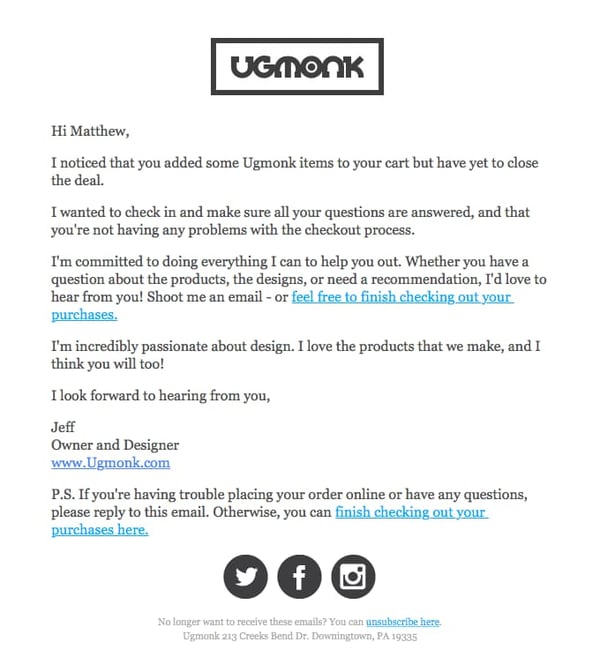
Let’s be real: your potential customers abandon their carts for a reason.
It’s a common misconception that people simply “forget” about their carts, or get distracted. There’s usually a very good reason why they choose not to proceed with their purchase.
And in order to create a cart abandonment sequence that reengages, you need to understand why your customers are abandoning their carts:
Do your competitors offer something you don’t?
At which point do your customers abandon their carts?
Which offers successfully reengage your customers?
For example, if your customers abandon their carts on the shipping page, your rates may not work for them.
The follow-up is crucial.
Send the first cart abandonment reminder immediately. Wait a few days, and send another. Finally, send your “hail Mary” offer.
Ugmonk’s example is a great example of a company that understands customers have underlying reasons for abandoning their carts.
If you sell services with lengthier sales cycles, reach out to customers who’ve abandoned their carts and ask them how you can help. This especially goes for B2B.
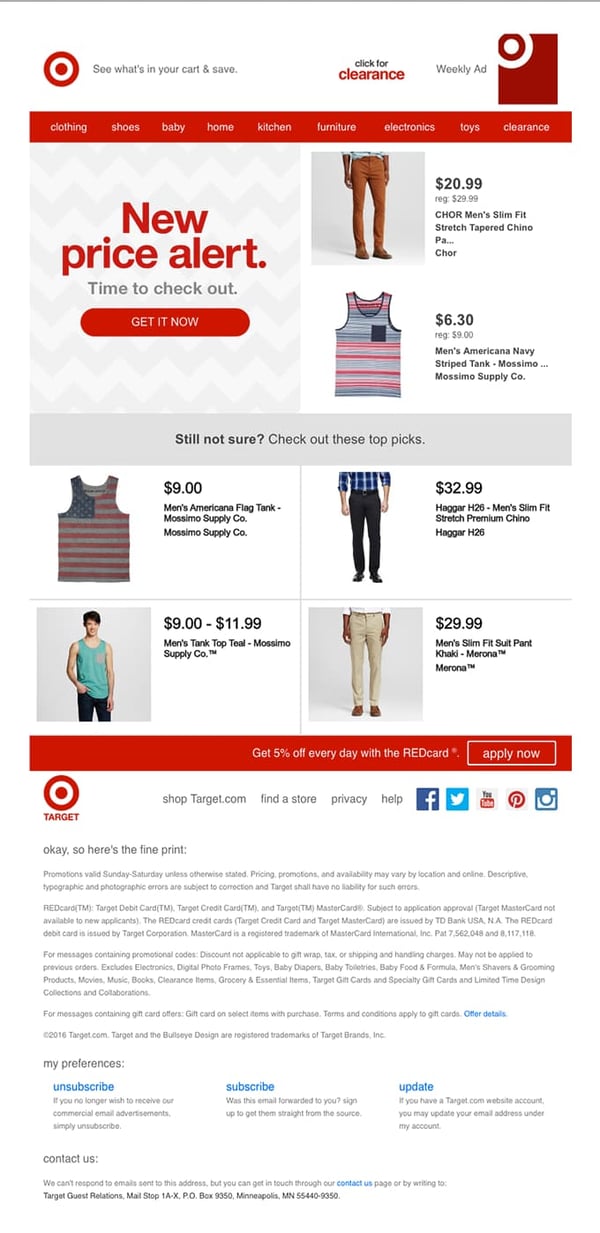
This example is perfect for companies whose customers respond well to price changes and discounts.
Again, this approach may not be the best for B2B companies.
Your prospects might value training more than they’d value discounts. But when you’re in the B2C space, you can’t go wrong with a discount.
5. Email Segmentation for B2B Companies
Even when you’re operating in the B2B space, you’re still talking to individuals. The only difference is: those individuals have higher-ups they need to convince.
You’ll just need to use different segmentation rules to win:
Industry
Job function
Seniority level
Organization type
How to Segment Mailing Lists by B2B Criteria
If possible, establish a detailed lead qualification process.
For example, if you’re using LinkedIn Navigator to reach new leads, you’ll be able to filter by industries and job functions.
If that’s not an option, you can still segment properly.
For example, you can start by asking for general information like name and email address Then, you can send a follow-up email to gather more information and personalize the experience.
Seniority level is also incredibly important.
If you’re communicating with executives, you know that they make the ultimate decision. Content like case studies and benchmark reports will be incredibly useful.
If you’re communicating with people who don’t aren't decision-makers, then you need to help them convince the decision-makers.
AdWeek are pros at communicating with other businesses.
They carefully tailor content according to different interests and niches.
If you subscribe to their newsletter you’ll be directed to a page where you can select the topics you care about.
And speaking of interests...
6. Email Segmentation by Interest
Now, we’ve covered some pretty advanced segmentation strategies.
But if you’re only starting out with email marketing, it can be too much.
You don’t have to establish complex segmentation strategies right away. But you can use one very simple aspect to personalize: interest.
How to Segment by Interest
You can start by tracking email opens.
Segment your subscribers into different lists based on the types of emails they prefer.
Pay attention to content similarities between different emails, especially if you’re selling different products.
The majority of email tools allow you to filter by subscriber behaviour:
Opens
Clicks
Bounces
Unsubscribes
You can use these metrics to create specific segments.
Another way of measuring interest is by evaluating offers subscribers respond best to:
Do they like exclusive products?
Do they buy during sales?
Do they prefer certain brands?
If you notice a lot of VIPs (people who like exclusive products), you can play on exclusivity in your emails. Invite them to be among the first to receive notifications about new products, and so on.
Vitruvi sends specialized product recommendations to customers who’ve shown interest in similar products. This email in particular addresses students and offers a solution that will help them focus.
You can easily gauge this interest type by monitoring leads’ link clicks, and the content they consume.
7. Layered Email Segmentation
Finally, you’ll receive the best returns from your email marketing when your models can accurately represent your customers.
What does that mean?
That means you need a layered email segmentation strategy. It will give you a complete understanding of different audience segments.
We’ve previously talked about segmenting by behaviour, demographic, and other factors. But if you’re ready to take your marketing to the next level, you should segment by all of these factors - and more.
As the image above shows, you can create a segmentation model that consists of different pillars.
You can use demographic data, as well as behavioural, psychographic, and geographic data.
The key is to use every data set relevant to your business.
How to Create a Unique Segmentation Model
If you’ve got a lot of customers and want to significantly increase your revenue, take a look at the data you’re currently collecting.
How are you personalizing your emails?
Which segmentation strategies were successful?
For example, maybe you’ve been segmenting based on opens and past purchases.
If someone frequently clicked on links related to socks and bought socks in the past, then it’s a no-brainer.
Try adding new data points.
For example, geographic data. You might notice differences between people who live in Argentina and Norway. Argentinians will buy socks in July, while Norwegians need warmth in December.
And that’s just the beginning.
The easiest way to get started is by creating customer personas.
When you understand how your customers make purchasing decisions, you’ll be able to leverage the right data.
The folks at Campaign Monitor highlight a great example of using different data points to create personalized experiences.
Our advice for taking such a strategy forward would be putting it into practice. Listing significant milestones is all well and good, but you can do better.
Once you notice a lot of customers sharing the same affinities, you can create entire personalized models; from carefully curated content to benefit-focused offers.
In this interview mailfloss chats with Talia Wolf, the founder of GetUplift, a conversion rate optimization agency. In the interview below, we pick Talia’s brain and ask questions about CRO as it relates to strategies within the world of email marketing.
The best-performing lead magnets are those that solve a specific problem for their audience. Meaning, that when someone signs up for your lead magnet, they walk away with actionable, specific details on how to solve a challenge they're facing.
Introduction
At mailfloss we’re focused on helping email marketers get the most from their email marketing campaigns. We do this in a few different ways. First, we help email marketers improve their deliverability through the use of our email list verification service. Secondly, we work hard to educate email marketers on the various topics relating to running a successful email marketing campaign.
Today, mailfloss had the opportunity to chat with Talia Wolf, the founder of GetUplift, a conversion rate optimization agency. In the interview below, we pick Talia’s brain and ask questions about CRO as it relates to strategies within the world of email marketing.
Without further ado, let’s jump into the interview.
The Interview
Hello and thank you for joining us today to talk about your involvement in the CRO space. Today we're going to ask a lot of questions about the relationship between CRO and email marketing. But before we do that let's talk about what drew you into the CRO niche in the first place? What is it about this industry that sucked you in and lever let you go?
Before founding my own conversion optimization agency, I worked in a social media agency. I ran paid campaigns on Twitter, Facebook, Linkedin, and other social platforms for our clients. I spent a lot of my time trying to figure out how to optimize my campaigns and landing pages we were working with. Endless Googling, reading, and researching would lead to making different changes on these pages and trying out new ideas that would hopefully drive conversions. It was through that research that I discovered the CRO niche. Back then everyone focused on driving traffic to their website, and conversion optimization wasn't something businesses put any focus on. The more I read, the more I fell in love with it and worked hard on getting better at it. It was in that agency that I met my future biz partners. They were just setting up a new CRO agency, and I wanted all in.
Now, when a lot of people think about CRO they think about increasing the number of people they convert into paying customers. A lot of people have a very two dimensional perspective about CRO. They associate CRO with doing things like changing the color of their add-to-cart button or adding social proof to their checkout pages. While that is part of the CRO process, it's only one small part of the process. In your experience, what are the three biggest mistakes that entrepreneurs make when they first approach CRO?
Through many failed and semi-successful experiences, I learned that conversion optimization isn't about changing elements on the page.
If I wanted to truly make a difference and create a high-converting experience, I would have to dive deeper and understand how people make decisions. I devoured books about psychology, decision-making, psychological triggers, and emotions. I run hundreds of AB tests and analyzed thousands of high-converting landing pages, emails, and websites. I quickly learned that conversion optimization is about solving people's problems. When you understand the motivations behind people's actions, the emotions that drive their decisions, you can create a high-converting experience that focuses on them.
The biggest mistakes I see are:
Not getting to know the people behind the screens - many marketers can breakdown the behavioral aspects of their prospects: their age, geographical location, the browsers they're using, and the devices. However, the only way to create truly high-converting experiences is to get to know the person behind the screen - their pains, challenges, fears, and dreams.
Testing random elements on the page, instead of hypotheses - Most people change the colour of the call to action button, reduce the fields in their form or "add some social proof" and believe that's where optimization starts and ends. Thing is, that optimization isn't about changing elements on a page, it's about solving your people's problems. Once you find a leak in Google Analytics, and identify that something needs optimizing, it's not enough to just make cosmetic changes on a page (changes that come from reading "best practices" or blog posts that promise 1000% increase in conversions by making one change), you need a hypothesis, you need to understand why this problem is happening, what's causing it, and do research to understand the strategic elements missing. Only then can you move in to fix the leak, by providing a meaningful change on the page.
Being features and product-focused - The most common answer to: "why do people buy from you?" is -"our product / our features/ our pricing/ we have the best tech" etc. Very product-focused. However, with hundreds of competitors out there, all offering similar solutions as your own, you won't stand out by talking about your product. We live in a world where we get pitched to dozens of times a day, and the only way to stand out in people's timelines or inbox is to make it about them. When you focus your message around your audience's desires, the challenges they go through, and their desired outcomes, when you make it about them, people care, they stop, they read and they convert. Brands that make their customer the hero, are the ones that stand out in that sea of sameness and win loyal, lasting customers/clients.
Where do you start when you first look at a website? In your experience, what has generally been the lowest hanging fruit for increasing website CR?
We run an extensive conversion optimization audit that starts at the heart of it all - customer research. After diving into behavioral analysis using Google Analytics, heatmaps, and other tools that tell us what people are doing on the website locates the biggest growth opportunities and show us what needs fixing, we move into the most crucial part: Customer research. Identifying how people make decisions, what drives them to action, surveying, interviewing, profiling, comparing and analyzing who our customer or client is beyond the raw data of age, geographical location, or browser. Our goal is to understand the emotions that drive people's decisions and then combine all this data to create better websites, funnels, landing pages, or emails that people connect with on an emotional level.
What are your biggest struggles or points of friction as a CRO company when working on client sites?
Sometimes it's a challenge to convince our clients to move away from being product-led, and helping them become more customer-led. Especially with very big organizations, branding is important, and they have very specific conceptions of what people need to know about them, and the solution they're providing. However, this is where the research comes in. We're able to easily show them what we learned, what people are saying, how they're behaving, and to pair our recommendations with the data that supports it.
Now let's jump in and talk about the intersection where CRO and email marketing intersect. You have a great post on your blog where you talk about the importance of lead magnets. Now optimizing for opt-ins is important because the more people you have on your list, the more people you can market your services to. How much A/B testing have you done with regards to lead magnets for your own (or clients') sites? What are some of the best converting lead magnets you've seen?
I see lead magnets as one of the best ways to form a strong relationship with your target audience. When you provide high-value content to your readers, you show your readers that you care about them, that you have relevant information for them, and when it comes time to sell something, they're more open to it because they know you're genuine.
The best-performing lead magnets are those that solve a specific problem for their audience. Meaning, that when someone signs up for your lead magnet, they walk away with actionable, specific details on how to solve a challenge they're facing. The specific type of lead magnet doesn't really matter (a guide, a quiz, a checklist, a worksheet, etc.), what matters is that people can immediately see the value of downloading it and how it will solve a crucial pain in their lives.
Now in terms of lead magnet placement and opt-in CR, what are some of the most important placements and design considerations? (i.e. pop up, exit popups, full-page popup, sidebar, etc). How much testing have you done around this?
We've ran extensive AB tests on this, both on our own site and our clients', and without a doubt, the most high-performing lead magnets are those that are configured to show up according to specific behavior. While an exit pop up may work well on some audiences, on others, a slide-in pop up might work better. The key to success is triggering these pop-ups according to specific behavior on the site or page, the more segmented it is, the more relevant it will be to people. We've had pop-ups configured to cover an entire screen after someone had visited the site 4+ times, scrolled more than 70% of a page and viewed at least 3 pages in one session, these kinds of pop-ups appear at the best time to our visitors with the most relevant offer and drive many sign-ups.
After signing up for a lead magnet, users are often sent a series of emails as part of a drip campaign. What's your advice to entrepreneurs who don't yet have a drip campaign in place? What are some email sequences you've seen work well?
My best tip is to analyze all the emails you've ever sent to your audience and find the most high-converting emails you've sent. The ones that have the most click-through rate, the ones you've gotten the most feedback on and analyze them. What worked? Why did it work? What principles drive this email? Then you can create similar emails or even create a welcome sequence that's assembled from your most successful emails.
Your end goal is to create an email sequence that connects with your prospects, builds relationships, and reminds people over and over again that you are a person/company worth listening to. Don't be afraid to write long emails (some of my most successful emails are over 1000 words long), don't be afraid to be yourself, use your own words, tone, and personality. Remember that it's all about connecting and creating trust.
When it comes to A/B testing emails, what are some of the most important elements to test?
Subject lines - subject lines aren't just about getting people to open your email, in some cases you'll get less open rates but more CTR.
Content - experiment with the type of content you send: formal, vs. personal, many links in your email vs. just one, long-form email, vs. one paragraph, and so on.
Design - our go-to at GetUplift is plain-text emails, the ones that look as close as can be to a regular Gmail email. We strip those emails down to the basics and now and then add a gif... other than that, no design. It's definitely worth testing!
In another one of your blog posts, you say that the magic behind sending emails that convert is to provide value. Can you tell us a little bit more about what you mean by this and provide some suggestions or examples?
Our inboxes are overflowing with offers. hundreds of emails hit our inbox weekly promoting some sort of offer or another. If you want to stand out in the crowded inbox and grab people's attention so they open your email, you have to show them, it's worth their while. Your goal is to provide the value your people subscribed for. When someone joins your email list, they're doing it for a reason, for a promise you made, they're doing it to solve a problem that you just convinced them you can help them with. Now you've got to prove it.
Sometimes that means offering a paid offer, yes. Your solution may very well be the best one to solve their problem, however in order for them to trust you, believe you and convert, they need to see that every single email you send is about them, their journey, and you keeping that promise.
Thank you greatly for taking the time to chat with the mailfloss email marketing blog readers today Talia. We really appreciate you taking the time. To our audience, if you’d like to learn more about Talia and the work she does, you can follow her on Twitter or head over to her website here.