Email marketing is one of the best marketing channels around. When done right, email marketing campaigns will drive conversions and offer a return beyond your wildest dreams. But when done wrong, you can bore and annoy your new unsubscribers. Let's not flub it, shall we? Follow our tips on 10 email campaign mistakes you need to avoid.
It’s been said that email marketing can offer a return of $32 for every $1 spent.
That certainly paints a lucrative picture while making you wonder why everybody running a business isn’t a multi-billionaire.
Well, the reason we don’t live in some entrepreneurial utopia is really quite simple; the numbers don’t tell the entire story.
Yes – whendone the right way – email marketing campaigns will drive conversions and offer a return beyond your wildest dreams.
Unfortunately, many well-intentioned marketers execute these campaigns the wrong way, making cardinal mistakes that land marketing efforts in recipients’ trash bins.
As marketing enthusiasts, it brings tears of sadness to our eyes when the powerful potential of email marketing isn’t fully realized. Especially when many emailing missteps are avoidable. In fact, there are 10 mistakes that happen far too often when businesses like yours try their hand at the email marketing game.
Read below for a deep dive into these clunky email marketing misfires so they can be avoided.
1. Writing Unengaging Subject Lines
There’s a harsh truth every email marketer must accept. People, for the most part, enjoy reading promotional material about as much as they enjoy falling from a 5-story building.
Furthermore, inboxes have been a prevalent part of society since the late 90s, meaning everybody is familiar with marketing emails. More specifically, they’re familiar with ignoring marketing emails.
And your target’s email-opening stinginess starts at the very beginning. Recipients are ruthless, callous, and unforgiving when faced with a flat subject line.
Studies show 50% of consumers decide whether to open an email based on the subject line alone. It makes sense because it’s the first impression which, if clichés have taught us anything, mean everything. Think about it, Romeo wouldn’t have won over Juliette’s heart if he broke the ice with “I have some tips for cleaning your gutter.”
A lifeless opening line will lead to your email’s premature demise.
So, you must be engaging and conversational. Maybe even ask a question.
For example, instead of a subject line like this…
…write a subject line like this….
The above example isn’t necessarily foolproof. You’ll have to assess what works best for subscribers. Make sure to monitor open rates so these numbers can be analyzed—which leads into the next common mistake…
2. Not using automated software
Marketing email analytics are crucial to the success of campaigns. They don’t just show what’s working, they also show what isn’t working.
There are times when small business owners tighten their financial belts to the point of outright suffocation. Commonly, this will stifle your ability to expand. It’s a tough balancing act but there are times when increasing your marketing budget can really pay dividends.
As the old saying goes: you have to spend money to make money.
Surprisingly, that’s not a conspiracy concocted by Wal-Mart, McDonald’s, and Apple to encourage extravagant purchasing. It’s downright wisdom.
Without spending on email marketing software, your campaigns will be akin to chopping down a tree with nothing but your bare hands. Not only do these various services track results, but they can also create engaging email templates, manage contacts, segment users into groups, and perform much-needed list hygiene.
Even with a tight budget and limited know-how, there are services out there starting at $10 a month. At worst, that’s worth the amount of time it would save you.
3. Sending Impersonal Emails
All it takes is listening to Elon Musk rant about artificial intelligence to become skeptical about the authenticity of, well, anything and everything.
Nowadays, it really seems like the bots are taking over. Yes, we’ll admit that the idea of owning a robot butler is enticing. However, perceptions of bot-written messages haven’t been great for email marketers.
Most recipients think they’re receiving a generic, impersonal communication sent by an uncaring bot. Not a passionate, hot-blooded human such as yourself looking to achieve the American dream.
Why? Because these particular emails aren’t personalized. Personalized emails have approximately 6% higher open rates than non-personalized emails.
Here’s where the aforementioned email marketing software becomes clutch. While sending an individual email to 100s if not 100s of thousands is impossible, that doesn’t mean each email can’t be personalized. With software, groups can be segmented so separate emails can be templated and catered towards the various target demographics of your consumer base.
It’s not good enough to just have a person’s name in the subject line. Emails need to speak directly to recipients. By segmenting your list into categories such as age, gender, interests, and professions, it will be easier to write relevant material. This is only really possible with marketing tools
4. Lacking a Value Proposition
The level of personalization seen in this email from Spotify is deeply layered, tracking the recipient’s listening habits then rewarding them for using the product by offering an exclusive pre-sale for tickets.
Spotify’s email offers something of value to the recipient.
Yet, many email marketing efforts aren’t accompanied by a valuable offer. Similar to luring bees without honey or attracting a Kardashian without money, this is a futile effort.
If you’re sending a newsletter, try sending subscribers helpful tips accompanied with a link to a podcast or an article (outside of your own content) that you’ve found helpful. Your recipients want emails that provide something more than a pushy sales pitch.
Or, you can plug your company blog at the end of an email, like the example below from Express Writers:
Although it’s your own blog, you’re still providing subscribers with something of value they can use in their everyday life – without having to purchase a product or service. In the above example, because there’s valuable information for content writers, Express Writers establishes itself as an industry expert. As a result, subscribers will indirectly be more invested in the product because the brand has established goodwill with the altruistic offering of their free blog.
5. Sending Emails at the Wrong Time
Even if you use an enticing subject line, state-of-the-art automated software, personalized messaging, and a value proposition, your email campaign can still go kaput.
How? With poorly timed emails. It’s like spending hours slaving away on a succulent roasted pig – only to serve it when everybody’s already gone to bed.
Analytics are also integral here (noticing a pattern?) because tracking open-rates at various times will provide valuable insights. Start by sending emails at one time, like 9 on Thursdays, for a few months. Then, switch to another time for a few months and compare the respective results.
Overall, it’s been reported that the best times to send emails are 6am, 10am, 2pm, and 8pm.
6. Sending Too Few Messages
Timing means very little if your email marketing efforts aren’t consistent enough. After all, the saying isn’t, “if at first, you don’t succeed, give up and don’t try.”
80% of deals need five touches or more before closing. Those numbers are as staggering as Jeff Goldblum’s immutable charm. The math is simple. By failing to send follow-up emails, you won’t be giving yourself the chance to succeed.
Yet, 70% of sales emails don’t make it past the first attempt. This means the majority of marketers don’t prescribe to the notion of persistence paying off. A huge mistake.
7. Sending Too Many Messages
Your email subscribers and recipients share a lot in common with Goldilocks. To satisfy their discriminating tastes, the frequency at which you deliver your marketing messages must bejust right.
Assaulting recipients with an array of weekly (or even daily) emails is one sure-fire way for the “unsubscribe” button to see an abundance of action. 69% of users unsubscribe due to receiving too many emails.
There’s a fine line between consistency and spam. And there’s a proverbial “sweet spot” that your campaigns must find to ensure the best possible results.
There are many factors impacting how frequent your marketing emails should be sent, such as the product or service and the nature of the emails. If you are regularly changing offers, sending out email blasts 2-3 times can work. But if the emails are more of a broad newsletter, twice a month might be better.
8. Sending Emails Without Visuals
Those new to email marketing might think it’s simply a matter of crafting a well-written message and hitting the send button. They forget that a picture says a thousand words.
Here’s what recipients see with a text-only marketing email:
The fact is, the average person doesn’t like plain text. And, according to 3M, the brain processes visuals 60,000x faster to visuals than just words. What’s more, is people will spend 10% more time looking at visual content than reading plain text.
With only text, your subscribers will feel like they’ve been sent a long-winded essay from their old university professor instead of being granted access to your latest and greatest offers.
Plus, bland text-only marketing emails are unprofessional. What does it say about a business when it won’t take the time to establish a signature look?
Not sure where to start? Any email marketing software worth its salt has a multitude of eye-catching design templates.
If the standard email template works for your business, simply adding a picture of a meme, gif, or thumbnail with a link will go a long way in engaging the reader.
9. Not Optimizing for Mobile
All the design prowess in the world is about as valuable as a kick in the pants if it’s not optimized for mobile devices.
In 2018, 52.2% of all worldwide online traffic was generated through mobile phones. Further research claims that 65% of email is opened via mobile devices. Meaning, those failing to optimize for mobile aren’t reaching the majority of online traffic.
Interestingly enough, although images and designs are important for memorable and engaging emails, going too far with them can hurt the mobile experience due to slow loading times and a lack of scrolling efficiency.
Here are some other tips for mobile optimization:
Utilize responsive mobile templates designed to fit phone screens.
Be smart with words in the subject line; an iPhone displays only the first 30 or so characters of a subject line when the device is held vertically.
Buttons are better for calls-to-action than links because they’re easier to click.
10. Forgetting a Call-To-Action
Speaking of calls-to-action (CTAs)—not using one is going to generate as many results as paying off your mortgage with Monopoly Money.
The CTA is the next step in the process where the recipient is helpfully directed to a landing page, product page, or blog, etc. Otherwise, what’s the point of the email? Simply to say hello? To try out your new stand-up comedy material?
There needs to be a method to the madness. Your CTA is that very method.
As has been discussed, buttons are generally better for CTA’s compared to links. For one, the resulting mobile optimization is invaluable, but secondly, buttons pop better visually than links.
CTA buttons should contain text that is large, legible, short, concise, action-oriented, urgent, and in the first-person.
Feeling argumentative and need more proof that CTAs are essential to email marketing? Wordstream reports that emails with a single call-to-action increased clicks 371% and sales 1617% compared to those without a CTA.
Conclusion: Practice Makes Perfect
Email marketing is particularly awesome because even if you make the above mistakes, it won’t cost much money in the long run.
Whereas an ill-conceived billboard, a poorly budgeted Google Ad, or splurging for an ineffectual television spot can all put a business in dire financial straits. These types of marketing strategies are highly expensive and require immediate results for anything resembling a decent return.
Such immense marketing spend is like going to Vegas without any of the good times and debauchery. Just the stress of hoping your gamble pays off.
Conversely, email marketing is inexpensive and gives businesses the breathing room needed to improve and nuance their messaging. Like going to Vegas but with nothing but house money, so to speak.
Thankfully, while developing your craft as an email marketer, there are helpful blogs with savvy insights and tips that’ll help you along the way!
If Charlie (of the Chocolate Factory) used email marketing, he’d have reached the factory much sooner. Email marketing is equal parts awesome and lucrative, which is exactly what makes it such a golden ticket. Companies all over the world realize that, in a shifting digital landscape, email marketing is still the best way to reach your audience right where it counts: In their inbox. And in order to help you get the 4400% ROI that email marketing provides, we’re taking a look at 30 profitable marketing campaigns to see what we can learn.
If Charlie (of the Chocolate Factory) used email marketing, he’d have reached the factory much sooner.
Email marketing is equal parts awesome and lucrative, which is exactly what makes it such a golden ticket.
Companies all over the world realize that, in a shifting digital landscape, email marketing is still the best way to reach your audience right where it counts:
Amazon has an amazing ongoing email marketing campaign that makes the most of user information and buyer journey.
From the first “Welcome” email which doesn’t contain any salesy stuff…
… to upsell and Black Friday deals (after you’ve made purchases) that know exactly what we need:
They’re constantly collecting information and using it to personalize emails for the recipient, staying in touch (multiple emails after making a purchase), and keeping the emails straight to the point.
Amazon knows their customers buy out of convenience, so there’s no “fancy stuff.” Just show ‘em the money!
2. BuzzFeed Keeps Emails Fresh
Look, regardless what we think of BuzzFeed (are they a site about politics or cat gifs? Maybe both? Nobody knows.) – they get results from their newsletters.
Why?
Because they cover different audiences.
They have so many newsletters that even they have to filter which ones to recommend. From politics and daily news to DIY and life hacks and cooking – there’s something for everyone.
And they know exactly what to recommend to whom because of email list segmentation.
Additionally, they know when to let images and headlines speak for them. Long intros and copy are reserved for editors.
Everything else is pure BuzzFeed fun.
3. PayPal Knows the Pain Points of Their Audience
PayPal realized how often people use their platform to share money between their friends and family, so they introduced a new way to split the bill.
Now, how are they going to promote it?
With email marketing, of course, and copy that reminds everyone of how fun it is to go out – but how un-fun it is when you have to split the bill.
Their service can help!
The trick of this campaign is that PayPal first makes the recipients relate to the situation, and then offers them an easy solution.
It’s as simple as it gets – and it’s profitable!
4. Make Them Feel Special like Tory Burch
There’s nothing we love more than feeling special, and the folks at Tory Burch understand it.
In fact, to show us just how special we are, they’ve integrated a gif with the motion of doors opening to say that we’re invited to a private sale.
With huge discounts.
Now, we’re definitely honoured. The gif makes us entertained. And since there are discounts involved, our next move is to click through.
It’s a tale as old as time, but it works great with email marketing!
5. Offer Something Extra like Starbucks
We all love coffee and Starbucks wants to be everywhere so email is a natural fit. But what would make us want to subscribe to their newsletter?
In Starbucks’ email marketing campaign case, they’re going to provide additional value if we visit them online.
Starbucks’ email campaigns offer news on coffee promotions, but they also offer news about discounts and a loyalty program.
So instead of just serving us with content, Starbucks makes the emails valuable to customers. Who can say no to 50% off mocha lattes?
6. WordStream: Targeting Professionals
No professional wants to crowd their inbox with a thousand newsletters, which is why WordStream keeps their emails direct and focused on actionable advice.
The copy is entertaining, and it segues into an article that’s chock-full of value for anyone who wants to advertise needs.
This email marketing campaign formula has been working for them for years, and it helps that they make business fun.
7. Headspace’s Email Marketing Campaigns Motivate
Headspace is a meditation app, and they put their customers’ needs at the forefront of any marketing effort.
After the New Year, they rolled out an email marketing campaign offering subscription discounts:
With this kind of product, the tone is important, and they set it with appropriate illustrations and copy. To motivate their users even more, they offer a discount.
After all, it’s time for new resolutions. So why not make one subscribing to their product?
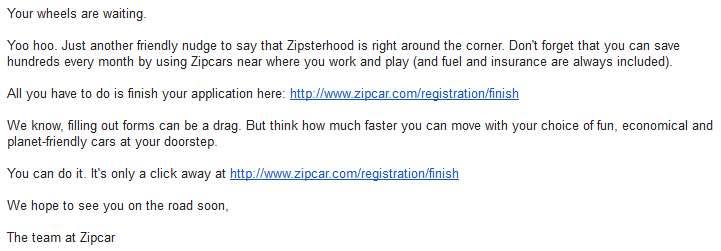
8. Unfinished Business? Learn from Zipcar
Customers abandoning carts is never a good thing, but it happens. What determines the outcome is how you’ll respond to it.
In Zipcar’s case, they send a friendly email reminding customers of unfinished business at their site:
While email marketing campaign templates are a good stylistic choice, they’re not necessarily what’s needed when customers are abandoning carts.
It’s much better to approach them peer-to-peer, with friendly copy showing the people behind the business.
It may be tugging at their emotions a little, but humanity is never bad for business.
9. Amaroso: Another Way to Approach Cart Abandonment with Email Marketing
If your product is tantalizing, put it at the forefront of your email marketing campaign directed at people who’ve shopped around but didn’t make a purchase.
That’s exactly what Amaroso is doing with their two-step campaign:
The first image is sent to shoppers an hour after they looked at products. The second is sent a few days later, just to remind them of Amaroso’s presence and amazing products.
After all, customers may have just been distracted, and they’ll appreciate the heads-up.
10. Show Understanding: Be like Loft
Loft gets a lot of points for being understanding of their customers’ inbox situation:
This automatically makes email subscribers like Loft more.
After all, they’re showing that they value their customers by asking them about their mailing preferences.
11. Skip Straight to Action like Bonobos
What’s the use of beating around the bush?
Bonobos know what their customers want: awesome clothes. That’s why they serve emails like this one:
The CTA direction here is very clear: select your size – pick your item – apply the discount. Bonobos didn’t write a lot of copy; instead – they offered a button to click on to go forward.
That’s all it takes!
12. Peak Design: Say Hi to Your Customers
Welcome emails are incredibly valuable, from showing your product offer to showing your brand’s personality. Ultimately, that’s what customers will stick around for – even if you raise the prices.
Peak Design covers all the important aspects: cool products, brand mission, values, and of course – actually saying hi.
13. Announce with Flair: RipCurl
Creating a sense of urgency is a big deal in sales and marketing. However, creating a sense of being a part of something immense is even more important.
RipCurl, for example, makes a bold announcement:
The time isn’t running out, but readers still get a sense that it is. And they need to get the watch. Everyone wears watches during a revolution.
14. The Art of Up-Selling: Bavsound
When Bavsound customers purchase audio upgrades for their BMWs, they get an automatic up-sell email recommending them products that go well with what they’ve purchased.
This is a great example of upselling with value. It’s not done randomly, but complementary. Forget about seeing ads selling you the exact thing you just bought; these emails use personalization and automation to sell you something you still need.
15. J.Crew: Treat Loyal Customers like VIPs
Perks are great, but there’s nothing like receiving an email marketing campaign where the head of the company is talking directly to you because you’re one of the most valuable customers.
In this J.Crew example, you can see how they’re putting exclusivity to work by giving their subscribers the first glance at a new collection.
16. Be Contrary like Huify
Would you ever write the following words in the subject line: “We dug through crap for you…”
Huify is doing everything right with their copy and placement, but the best thing they’re doing is acknowledging that a lot of content is… well, less than stellar. And that subject line gets a lot of attention in crowded inboxes – it got a 37% open rate.
17. Go Smooooooth with Copy like Cuyana
People don’t just buy the products – they buy the lifestyle. That’s why evocative copy can go a long way towards making people buy your product sooner.
And when exquisite copy is paired with quality products and tantalizing images, we’ve got ourselves a Cuyana-level email marketing campaign.
18. Know When They’re Running out of Your Product like Rockin’ Wellness
If you’re selling perishable products, know when your customers will be running out of them.
And then send them an email reminding them that they should get them replenished, just like Rockin’ Wellness did.
19. Missguided: Reactivation? No problem
If your customers aren’t active lately, get in touch with them to see what’s up.
Make sure you add an enticing offer and focus on what you want to express with the message.
20. Don’t Be Afraid to Be Bold: The Limited
When something doesn’t need to be explained, but it’s still a Big Deal – do like The Limited did and increase font size:
Joking aside, increasing the font size and using bold visuals can go a long way towards getting the attention of your customers. And then all you need at the end is a CTA button with a good offer.
21. Kate Spade: Experiment
In the era of standardized email templates, the folks at Kate Spade did a great thing by experimenting with the format:
This not only caught attention, but it showed personality as well.
As since there’s a discount involved, you can bet the CTR was higher than the Empire State Building.
22. Solve Your Subscribers’ Problems in Your Email Marketing Campaign
We have to take another look at J.Crew because they’re just that good. A big part of the B2B newsletters’ appeal is problem-solving. And when it’s applied to B2C, it works great!
And who’d say no to a personal stylist?
23. Check Deliverability, in a Cool Way
There are some companies that just do email marketing right, and Bonobos is one of them.
The visuals are fun, and the CTA can provoke a great answer from subscribers. After all, there’s only one choice.
This is actually a re-engagement email masked as email deliverability check, and we’re loving it!
24. Tiffany & Co: Sell the Wish, not the Product
Do we buy engagement rings because they’re beautiful, or because we want them to signify something greater?
By reconnecting products to romance, Tiffany & Co reach the hearts (and wallets) of many subscribers. There’s even an option to send gift ideas in the red bar!
25. Referrals with Starbucks
Email marketing campaigns can be used to encourage subscribers to refer their friends, as well. All it takes is a good offer, and a beloved product:
26. Need More Info?
If you need more information from your subscribers, there’s no need to be creepy. Just follow Overstock’s birthday example (and then give them a birthday gift when the time comes):
27. Loft and the Meme Potential
Loft uses pop culture right with their email marketing campaigns, and so should you.
Use them; you’ll make your subscribers laugh, and if you can make them laugh, you can make them do anything.
28. Pinkberry: Don’t Ask What Your Subscribers Can Do for You
Show them what you can do for them, just like Pinkberry.
Instead of sending a survey to re-engage their inactive subscribers, give your subscribers a reward.
29. 1Password: Sounds Just Like Home
Just because you're an unsexy, but highly useful password software service doesn’t mean you can’t stir up positive emotions of home, comfort, and safety:
Only 10% of sales is about the actual product. The remaining 90% all about the benefits and the goals that your customers will be able to achieve with your product.
30. If All Else Fails, Be You
Just kidding. Personality is always a good idea in email marketing campaigns, especially if there’s a person at the forefront of your brand.
After all, bots aren’t reading your email. Humans are. And they want to connect – with nice shoes, courses, software, and people.
Our biggest feature request to our Infusionsoft integration is live. For invalid email addresses, mailfloss can now update contacts with tags inside of Infusionsoft. You’ll see this as one of the options in manual mode here: Or, if manual mode is turned off, it will be one of the available options, seen here: If you […]
Ever wondered how email verification works? In this short article, we explain the general process, why it matters to your bottom line, how long it takes, and a method to get it done for you automatically.
If you’ve ever had to work in email marketing, you’ve probably had a headache or two because of email verification (or a lack thereof). We'll explain how email verification works and why it's important to your email marketing.
Email marketing starts off simple: you do your best to get a few hundred people on your mailing list through blog content, lead magnets, and other opt-in goodies, and then you start sending email newsletters using a popular Email Service Provider (ESP). Congratulations, you’re now an email marketer.
But with time, you realize that something is going on… What was once an active and engaged email list is now one that’s on life support. Your emails aren’t getting through, they’re bouncing, and for every hundred subscribers, only ten are receiving your emails. That certainly is the case with 48% of global mail that’s being marked as junk.
What? How? Why? This is because your email deliverability is decreasing. Here’s an article we wrote on email deliverability explained in a way marketers can understand.
An important way to improve your email deliverability is through a process known as email verification, and to help you understand how it can impact the success of your email marketing, we’ve dug in deep. Let’s improve your email deliverability!
What Is Email Verification?
Email Verification is the process of verifying an email address is valid and improving the odds that it belongs to a real person. The whole purpose of email verification is to ensure that a real person with a valid email address will receive and interact with the sent email.
So what happens when you send an email campaign to a lot of addresses that aren’t valid anymore?
Your bounce rate increases. This sends a signal to ISPs that your sender reputation shouldn’t be high.
If your sender reputation isn’t high, your emails may not reach the inboxes of your customers with valid email addresses.
You get poor email deliverability and open rates because you’ve been sent straight to the Junk folder.
All in all, you’re not making it to the inboxes of your subscribers, and that directly translates to bad ROI.
Verifying Your Email Address
Since there’s a lot of spam and frauds out there, ISPs are doing their best to protect their consumers from harm. Even though you may have the best intentions, you can still get falsely marked and blacklisted as a spammer.
We’ve written an article on how to authenticate your email address and improving your sender reputation so be sure to check it out and ensure that your emails are reaching your customers.
How Email Verification Works
Email verification is a process of verifying emails involving a series of steps that can help you improve your email deliverability.
The following is the general process on how email verification works, although different verification services have different steps and verification methods.
First, it identifies any issues and possible problems before they’re caught by ISPs or ESPs.
It’s actually just like spellcheck – making sure you haven’t misspelled anything before handing in that paper that’s due in 15 minutes.
Email verification usually involves checking your mailing list for spam traps – email addresses which have been created with the intention of capturing senders who aren’t following proper practices.
If you’ve been buying mailing lists, chances are you’ve got a few of them. But even if you’ve legitimately acquired email addresses, there can be one or two of spam traps on there.
Email verification makes sure that these addresses are removed from your mailing lists. Otherwise, if you send an email to a spam trap, you’ll either be asked to remove that address from your list, or you’ll be blacklisted by ISPs and ESPs.
The next thing that happens with email verification is that the provider checks the format of your emails (formatting & syntax check). This includes scanning your mailing list for missing @ symbols, invalid email addresses, and other things that could result in a hard bounce.
For example, if someone put in this email address: john@john@dd, this is where email verification would catch it.
The next step of the process is domain verification. The service checks the DNS records to make sure that the domain name is correct, and that the domain mail exchange server is able to receive emails.
For example, if someone entered this email address: john@johnski.dd, if there’s no domain registered under johnski.dd, email verification would mark it as not valid at this point.
The final step of the process is individual mailbox validation. For this, email verification services use the SMTP protocol to make sure that the mailbox exists and is able to receive messages.
Let’s use our John for this example, too. Let’s say John made a mistake and instead of writing john@johnski.dd he wrote: jehn@johnski.dd. The email verification would at this step send a signal to verify whether this mailbox is able to receive messages. Once it’s clear it can’t, you’d be notified that the email address is not valid.
Poor John.
If the email verification was performed correctly, congratulations, because you’ve just successfully protected yourself from potential blacklisting and having your email deliverability impaired.
That's essentially how email verification works.
At mailfloss, we do a number of additional checks to remove low engagement and low quality email addresses such as role-based emails, disposable addresses, bounced emails, complainers who mark emails as spam, and so on. In all, we have over 15 checks that we go through to ensure we’re keeping your email lists as clean as possible.
How Long Does Email Verification Take and How Can I Do It?
Usually, email verification takes less than a second, and it’s done without sending out a single email (otherwise that would be very bad. Imagine receiving an email saying “Please respond if you are a real person”).
You should get your results right after email verification is complete. You can see which email addresses are hard bounces and should be removed, which are disposable and fake, and which are just straight-up invalid.
You can verify your emails by batch-uploading them to an email verification service, or by connecting an email verification API that checks your email addresses. The second is generally a better choice as you’re able to prevent issues from occurring in real-time, but require a developer and can be costly if you have limited budget and resources dedicated to development.
Batch uploading, on the other hand, doesn’t require development resources but is a pain in the ass in its’ own right. You have to export your email list from your ESP, wait around until the file is ready to download. Download it, then upload it to the email verification service, wait around, and then download the results. Then you need to go back into your ESP and clean out the list based on the results. Shoot me now. Does that sound like fun to you? Get out the paint, paint your desk. Watch it dry.
Or you could try mailfloss. It’s better than both options because it automatically handles the entire process from beginning to end for you. Simply connect your ESP, set your preferences, and let mailfloss handle the rest automatically (you won't need to know how email verification works since it's done for you).
If you want to make sure that you’re getting full email deliverability, make sure you’re also regularly updating and checking your mailing lists, and staying away from shady practices.
That’s what’s going to get you the best return on your email marketing investment.