In this interview mailfloss chats with Ardath Albee, a B2B marketing strategist with over 30 years of business management and marketing experience. She’s a strategist, storyteller, speaker, blogger, teacher, and content geek who is obsessed with helping companies become so damn relevant that buyers can’t help but choose to become customers and, once a customer, making sure they’d never think of leaving.
A buyer persona is a composite sketch of a target market based on validated commonalities that actively informs content strategy to drive productive buyer engagement.
Introduction
At mailfloss we’re focused on helping email marketers get the most from their email marketing campaigns. We do this in a few different ways. First, we help email marketers improve their deliverability through the use of our email list verification service. Secondly, we work hard to educate email marketers on the various topics relating to running a successful email marketing campaign.
Today, mailfloss had the opportunity to chat with Ardath Albee, a B2B marketing strategist with over 30 years of business management and marketing experience. She’s a strategist, storyteller, speaker, blogger, teacher, and content geek who is obsessed with helping companies become so damn relevant that buyers can’t help but choose to become customers and, once a customer, making sure they’d never think of leaving. Today, mailfloss was lucky enough to chat with Ardath about effective ways to use email marketing to reach (and convert) your target audience.
Without further ado, let’s jump into the interview.
The Interview
Hi Ardath and thanks for joining us today to talk about your experience in the marketing space. Today we have an interesting interview planned with you because a lot of the areas of focus do not deal specifically with email marketing but are interesting when looked at through that lens. So let’s kick off the interview by talking a little bit more about how understanding buyer personas has the potential to increase the impact and effectiveness of an email marketing campaign.
B2B buyer personas are actually integral to the effectiveness of an email marketing campaign. The purpose of sending a marketing email is to get a click. Period. The best way to get that click is with a message that resonates with your target audience. And the best way to create relevant content is to really know what your audience cares about. Buyer personas are the tool that informs your content strategy and messaging – including your email marketing campaigns.
To do a level set: “A buyer persona is a composite sketch of a target market based on validated commonalities that actively informs content strategy to drive productive buyer engagement.”
The keys to that definition are target audience and commonalities. Base your persona on role, not title. There can be many different titles for folks with the same responsibilities and objectives, so focus on role. Then identify the things they care about that they have in common. The objective of a buyer persona is to help you engage the widest swath of your target market by focusing on the things most relevant to as many of them as possible.
As you mention on your website, buyer personas help businesses create content that their target audience may relate to best. What low-fi, low-cost strategies can smaller startups use to help them build and better understand their buyer personas?
If you have a phone, you’ve got your low-fi, low-cost option at hand. The secret to buyer personas, that actively inform marketing strategy, is talking to your customers. It’s best to talk to those who have purchased within the last year to 18 months because you want them to remember their buying process – what questions they had, what resources they used, what the tipping point was that put them in market, etc.
I’ve found that it’s best to only ask for 30 minutes from each customer if you want to get your interviews scheduled quickly. Asking for more delays the process. And, they’re helping you out. Make sure you’re ready with the questions to ask and that you don’t waste time asking something you can learn from their LinkedIn profile, closed-end questions, or anything that isn’t actionable. For example, demographics, family situation, salary, lifestyle are not things you use in B2B marketing.
Some questions to include:
Can you tell me about a day in your life – what are you responsible for and what are your top priorities?
What happened that had you looking for a (your solution)?
How did you go about researching your options? (What other things did they consider? It could be something other than your direct competitors – you want to know that)
What did you need to learn – what questions did you have?
Once you narrowed down the options, what did you do?
What online resources did you use?
Who else was involved in making the decision? (buying committee)
Was there any push back from others you had to overcome to get to consensus?
Why did you choose us over your other options?
The other thing you’ll want to do is talk to your sales reps and ask them who they engage with at prospect companies and what questions they’re being asked. Ask them why buyers in deals they lost chose an alternative. This helps validate what you’ve heard from customers. I recommend you do this before you build personas, so you know you’re building personas to attract the right prospects that your sales reps want to engage.
There is no substitute for talking to your customers. If you make up the buyer persona based on what you think, you’re not only introducing bias (you’re not the customer) but you’ll also lack the nuance that helps you differentiate your messaging from that of your competitors. There’s a reason your customers choose you over the competition. You need to know what that is.
Once they start better understanding their buyer persona, how should this impact the content contained within their email marketing campaign?
One of the most off-putting things about marketing content is when we use language that is ours, not that of our buyers. Research conducted with buyers shows they’re begging for relevance and for marketers to stop the fluff and overt sales pitches. The truth is, they don’t care about your products, they care about what outcomes they can get that they couldn’t without them. They want their problem solved.
Listen carefully to how your customers talk about their industry, the problem they were solving and the outcomes they were looking for. Use those words and phrases in your email messaging and marketing content. You’ll find much higher levels of engagement because your content will resonate with them naturally.
On your website, I really like how you say, “one-off content is not content marketing.” Would you also argue that one-off emails are not email marketing? Why / why not? How do you approach building a bigger strategy around content marketing?
One-off anything is a bad idea in marketing – in my opinion. The more connected the story you tell, the easier it is to gain and keep attention across the long haul.
For example, let’s say you create an email marketing campaign that has five touches and lasts for two months. If it takes prospects an average of six months to go through their buying process you’ve just cut them off at the knees when your campaign ends at the two-month mark. They’ve engaged. They’re interested. They’re following along…and then…nothing. But then you start your new campaign and they’re sitting there wondering what happened to the “story” they were interested in learning more about?
Buyer personas will help you understand what the entirety of the buying process entails so you can focus on building that story and moving them through it (and through their buying process) as it unfolds. The additional benefit you have is that taking a “serial storytelling” approach to your email marketing programs also helps them remember your brand. You’re the consistent one they can count on for more of the information they want and need. You’ve got staying power and consistency. A key part of the buying decision is how they feel about you as a vendor – not just your product. Showing them how comprehensive your expertise is to help them goes a long way.
And, in case you think running a continuous campaign is limiting, it’s not. Your personas will help you see that. Remember when you interviewed them and asked what they needed to learn about to make the buying decision? Answering those questions is one key to creating a compelling story with your buyer as the hero. And, the beauty is that as more questions come up, you can add them to the story and keep expanding it over time. No more reinventing the wheel for every campaign.
You also mention on your site that content marketing is an “orchestration of relevant ideas and concepts that resonate with all of the different perspectives on the buying committee”. Can you tell us a little bit more about what you mean by“orchestration”. What parts are at play here?
One of the things we’re not privy to as marketers are the conversations that go on internally with our customers. Depending on what types of companies you sell to, this can include 11 or more people – all with differing roles and perspectives. Our content needs to address those varying perspectives to help our buyer get them all on the same page. So think about the opportunity to send an email to your buyer with a message about how “this content” will help their (Director of X) understand the value of choosing (your product) to solve the problem. Here’s what’s in it for them…
As you point out on your site, buyers are “self-educating”. Can you tell us a little bit more about the intersection where education and email marketing meet? In your opinion, how important is education as an email marketing content type?
Education is critical. Think about it this way. Even if your prospect has purchased what you sell a few years back, chances are that there are new things to consider now. Think about how fast products evolve, technology most of all.
But take a step back from that. Your prospects likely have a way to do whatever it is that your solution solves for today. They may not even realize they have a problem. Or they may know they have a problem but don’t understand what they can gain by fixing it or the true cost of not fixing it.
Your audience is most likely to spend time engaging with your email if it teaches them something new or provides a new perspective to consider. Education comes in many forms. I’d argue that nearly all marketing is educational in some way. Why do your prospects read your case studies? I’d say it’s to learn how others, like them, solved the problem they’re facing by choosing your solution.
You also mention that content must serve as an enticement to push people to engage with your sales reps. You mention that “getting prospects in sales conversations is a primary objective of digital content strategy.” How does this play out as it relates to email content?
There are many ways to answer this question for B2B. The first is that the whole point of content marketing (and arguably email marketing) is to create engagement with customers and potential customers. If your messaging and the content you share are focused on addressing your audience’s needs in a way that’s relatable and helps them see themselves solving their problem, prospects will reach out to speak with sales as a result of that value provided.
Another way to answer this question is that if your nurturing program is well designed and engagement is high, then there can be several trigger points where sending an email asking them to request a demo or a conversation with your sales team is appropriate – and may just be the nudge the prospect needs because it comes at a time when they’re ready to take a next step.
A third way is to create email sequences for your sales reps to send out to the prospects they’re pursuing, offering valuable insights in exchange for a conversation. By helping create this sequence, you have a better shot at having the story your sales reps are sharing match the story marketing is sharing so you have a consistent narrative across the buying cycle. There’s nothing worse than a prospect thinking they know “you” and then receiving an email from a sales rep that’s completely out of left field given the content they’ve been viewing.
You also believe it’s content that will set a company apart from its competition. What do you mean by this and how would you respond to people who would disagree with you and say it's primarily the product that separates one company from another?
Nobody cares about your product. Period. No one. What they care about is what the product can do for them that they couldn’t do without it. They care about what’s in it for them (WIIFM) which generally means solving a problem that’s keeping them from meeting objectives.
In a B2B complex purchase, there’s a lot of inherent risk. People get fired for making the wrong choices. A B2B complex purchase is a major change management initiative. It usually means that people are going to have to change to adopt the new solution. People don’t like change – including your buyers. There are two things that I’ve seen become primary reasons why purchases result in no decision or a lost deal.
The buying committee can’t reach consensus because they can’t deconflict all the various information each person on the buying committee brought back. Because they can’t agree on which perspective to believe, they end up not choosing to change and stick with the status quo. Let’s hope that’s not based on solution brochures from your company that misrepresent your product!
The second reason is that they felt the vendor wasn’t a good cultural fit and the product they were buying was pretty much the same across the final vendors they were evaluating (the buyer’s perspective). Prospects see most products today as commodities and are looking for that something special from a vendor that has them feel like a partner. It’s called trust.
To apply this to email marketing, it’s important to consider the emotional component of your emails. How does your audience feel when your email hits their inbox? Do they snarl, think ‘you, again’ and hit delete? Or do they open it with anticipation to see what helpful information you’re sharing today? Those are pretty much your choices. Obviously, you want the latter response. What drives that is the content and messaging.
In answer to the first reason above, provide clear information focused on adding value to your prospect’s search for an answer to their challenge. In answer to the second, exhibit the qualities that builds a predisposition to trust you based on the quality of the information your email deliver. If your sales team exhibits this same care and value, the consistency of experience will keep your prospects predisposed to choosing your solution – as long as the product delivers what they need.
Lastly, let us throw a hypothetical scenario at you. You’re offered a new job at a small startup with no formal marketing department. You’re given one week on the job to implement the three most important systems or processes that will help this company grow in the long run. What are the three things you work on this week and how do you get them off the ground?
The three things I’d implement are:
Buyer personas
New positioning and messaging on the website
Launch a blog
I made several assumptions and one week isn’t a lot of time. I assumed that the website was passable, but not really showcasing a kick-butt, buyer-driven story. In order to change this, I’d need to talk to customers quickly to discover the story that will stick and pull others in. If I can get 10, 30-minute phone calls with customers, I can do this – or at least a phase 1 buyer persona – enough to get started. Quick chats with the sales reps and founders will give me additional insight I can gather quickly that will help to ensure alignment between the company and its target market.
The other assumption I made is that the startup needs awareness and content for the sales team. A blog can help with both. Buyer personas will identify the questions your prospects have and what they need to learn to buy your product. Answering those questions gives you an editorial calendar for the blog.
Once you have those things, you can do a lot to have marketing contributing to the startup. And, it’s important to consider that in a startup, marketing must wear a lot of hats. Sales enablement is one of them.
Thank you greatly for taking the time to chat with the mailfloss email marketing blog readers today Ardath. We really appreciate you taking the time. To our audience, if you’d like to learn more about Ardath and the work she does, you can follow her on Twitter or head over to her website here.
Want to write effective subject lines? This useful and concise guide will give you the step by step on how to write effective subject lines, with plenty of examples of brands and businesses doing it well.
According to Statista, there were 3.9 billion email users worldwide in 2019 and the figure is projected to reach 4.48 billion users in 2024. This indicates that e-mail remains to be an indispensable tool for daily online communication.
While promoting a product may be part of a brand's email marketing strategy, the strategy may fail if the subject lines stink. Most marketers view subject lines as an afterthought added to an email before hitting send.
The subject line gives life to the entire email. It determines whether a reader will open the email and that's the most important first step.
It's every digital marketer's wish to have their emails generate potential leads time and again. Discussed below are some of the proven steps that can help spice up subject lines and improve the engagement of an email.
1. Always Start With the Subject Line When Composing the Email
Regardless of what marketers say, people will always judge their emails by the subject lines. The amount of attention paid to the subject line will determine whether an email serves its right purpose. Many marketers test different email subject lines as a way of optimizing the performance of their emails. It's increasingly important to make the subject line as compelling as possible for people to open the email.
The very first impression a recipient gets of an email is the subject line. Marketers can use them to make their emails stand out from others in the recipients' inbox.
One of the most common mistakes made by people when composing an email is to omit the subject line. It's easy for an email to get lost or go unread in a recipient's inbox if it comes with a blank subject line.
It's best to first write the subject line and then proceed with the body of the email. A subject line not only determines the likelihood of an email being opened but also how the recipient will act after reading the email. Most people may delete an email with a crappy subject line. Or they'll get irritated by it since they don't know what it's meant to convey. Think about your own usage of email. Are you opening up emails from Nigerian Princes?
Beginning a draft with the subject line helps set the tone of the email and ensures the reader doesn't ignore it. Below are some examples of a compelling email subject line:
Udemy: "New Year, New You! Make Your First Website"
Beardbrand: “[New Video!] Dealing with Beard Patches”
2. Begin the Subject Line With the Most Important Words
According to PEW Research Center, 81 percent of Americans own smartphones. This means that a huge chunk of the population reads emails on their smartphones. Since less text is visible on smaller screens, it's best to start the subject line with the most important information.
Compelling details of the subject line may be cut off due to the screen size of the phone a recipient is using.
Filler words make the subject line look bad and unprofessional. Avoid using filler words such as "thanks", nice to meet you, or "hello", which are best suited for the email's body.
Do inform the readers what's inside the email. For instance, if a visitor downloaded an offer that made available on a website, a compelling subject line may sound like this:
Digital marketer: "Your cookbook awaits inside!"
Wish: "Everyone is obsessed with this $1 button controlled wireless selfie stick."
Using this type of wording makes it clear that the recipient should anticipate something in the email.
3. Avoid Using All Caps or Overusing Exclamation Points
Exclamation points are a great way to capture a reader's attention. However, using them in excess may make a subject line appear as if it's trying too hard to capture the recipient's attention.
Avoid, at all costs, using all caps in the subject line. All caps may make the email appear as if the sender is telling the reader.
A subject line with the words, "Clearance sale is on now!!!!!" or "YOUR SHOPPING VOUCHER AWAITS YOU" won't get an email opened. In fact, the recipient may treat it as spam and get annoyed at the sender.
A report by Radicati suggests that 85 percent of respondents prefer receiving an email with the subject line written in all-lowercase versus all capitals. All caps looks spammy and might land you in the Spam folder, anyways.
Instead of using disruptive techniques to grab the reader's attention, it's best to use delightful language, establish relevancy and, personalize the email.
Great examples of email subject lines without caps or overused exclamation marks:
Jo-Ann Stores: "Today only! Big Savings on 2 Singer Sewing Machines."
Violet Grey: "Get Them Before They’re Gone"
4. Use Simple, Focused, and Concise Language
It's best to focus a marketing email on one action, which the subject line should highlight. Offer one takeaway. Specify how to deliver it. And indicate how readers can make great use of it will help keep the email focused and concise.
An email stands a chance of enticing its recipients if the subject line has clear and concise language instead of flowery and complex language. It's advisable to think about the benefits the recipients will derive from the email. Making these benefits clear may help persuade the reader into clicking through the email.
For instance, a subject line that sounds like:
"Increase sports betting profits in your SportsBet dashboard. Here is how to do that."
won't be as appealing as one that sounds like:
"Double your sports betting profits by 50% today."
Some great examples of short, sweet, and focused email subject lines are:
Zillow: "What Can You Afford?"
Uber: "Ride into 2020 with Uber."
5. Create Actionable Subject Lines
Just like calls-to-action, subject lines build anticipation for people to click on a specific item. Beginning them with action verbs will help increase their likelihood of being more enticing to the readers. The more enticed the recipients are, the more clickable the emails become.
Action verbs add a vibrant touch to the subject line. They instill a sense of excitement and urgency, which is crucial to a marketer looking to inspire more readers to click on an email.
For instance, an email welcoming new subscribers to a mailing list should read:
"Enjoy fitness and nutrition tips from our team of experts."
It would sound less actionable and more generic if it was written:
"Fitness and nutrition tips from our team of experts" .
The first email uses the verb "enjoy" to sensualize what the readers will experience after subscribing to the sender's mailing list.
Another example of an actionable subject line that pushes people to take action is:
Amazon: "You're invited: Getting Started with Containers on AWS Webinars (25-28 May)."
6. Caption the Subject Line With Words That Make the Reader Feel Important
While the attention span of readers tends to vary, emails with long subject lines don't get opened. It's advisable to use at most 50 characters to ensure that the reader goes through the whole subject line.
Don't include frivolous details and words in the subject line. For instance, a subject line like "Your Amazon.com Order" is better than "Order #737737483768 has been received and is currently being processed".
The same applies to the body of the email. Avoid including the words "newsletter" or "broadcast" when writing the subject line. Such words have a higher likelihood of reducing the open rate of the message. These words suggest to the readers that an email is generic. Nobody cares about your newsletter. They care about reading a relevant and valuable email sent to them at the right time.
A short subject line should infuse the psychology of exclusivity.
Make the recipients feel like the email was written for them and nobody else. The subject line should make them feel chosen to increase their chances of clicking through the email. With the right wording, readers can feel special and, in turn, be motivated to take a specific action.
Examples of heart-touching subject lines include:
American Eagle: "1 DAY just for you, Tim!"
Amazon: "M3 – Get deals tailored for you."
7. Add a Familiar Sender Name
Readers are more drawn to an email with a familiar sender name than one with an anonymous or unfamiliar name. A realistic sender name (like Janet@thecompany.com, for example) is less intimidating and more inviting to the recipients once the email reaches their inboxes.
It's advisable that marketers use their own name in the sender's address if they've already familiarized themselves with the recipients in a previous message. If it's a business, the customers will believe that they're working with an individual rather than an entire organization.
Most people are likely to ignore an email with a sender's name they're unfamiliar with even if the subject line is compelling. Readers may ignore such an email if they don't know who it's from. The lack of familiarity makes it difficult for them to believe that the email will encourage a friendly conversation.
Marketers should avoid using the automated "no-reply sender name since it portrays them as unfamiliar senders to the recipients of their emails. No one wants to open an email with such an address since there's a likelihood it may be spam. Some may think that it's a robot that sent them the email.
An example of such an address is "noreply@thecompany.com." A realistic sender name like “janet@thecompany.com” is less intimidating and more inviting to the recipients once the email reaches their inboxes.
8. Time the Subject Line in the Right Way
Timing is everything when it comes to email marketing. An email's subject line can help add the aspect of time and create a sense of urgency and importance.
Consider this example:
A fashion retailer that sends an email with this subject line, "Final Hours! 40% off Soaps and Lotions", is likely to engage with the readers looking for lotions if they feel a sense of urgency.
Great examples of time-bound subject lines:
Warby Parker: "Uh-oh, your prescription is expiring"
King Arthur Flour: "The timer’s going off on your cart!"
Timing is everything. A subject line that's written in the right way can motivate the reader to open an email since it creates a sense of urgency. Including a call-to-action in the email's body will help tell the reader to attend to the urgency by performing a particular task.
9. Include Personalization Tokens in the Wording
Creating rapport with the reader should be among the things a marketer should aim for when sending out emails. Personalization tokens, which make the most out of locations and names, help add a sense of rapport in an email.
Mention the recipients' name so the email will feel like it's written to them. People like it when you mention their names. It feels more personal, as if the email is for them.
Besides building rapport, personalization tokens are a great way to drive more click-through rates. Recipients are more receptive and willing to take action on emails with subject lines that mention their first names.
For instance, streaming service Netflix uses personalization tokens (names) to remind their customers with subscriptions that are nearing the expiration date.
Netflix: "Brenda, your Netflix free trial is almost coming to an end."
With this example, it's clear that the sender timed the message and personalized it right.
Overusing the personalization tokens may make the subject line sound creepy.
Add little bits of them, here and there, to indicate to the recipients that you know more about them than just their addresses. Second-person pronouns such as "your" and "you" can also work in the place of personalization tokens. They'll sound like the sender is addressing a recipient directly.
For example:
SumoMe: "If you have a website, you need this tool."
Email subject lines are supposed to help senders promise the reader something in the message. Marketers should always ensure they stick to the end of the bargain. Making false promises isn't a good way to go.
The audience may get annoyed by such behavior and lose trust in the brand the sender is trying to market.
If a brand's emails fail to fulfill the promise made to their readers, guess what will happen? Yep, the emails will have significantly higher unsubscribe rates and a lower click-through rates.
Examples of subject lines that make fake promises include:
Shady marketer: Get rid of acne in two days with this one weird trick!
The Bottom Line: Writing Effective Subject Line Is Essential for Email Marketing Success
Ultimately, emails that aren't opened by the recipients aren't seen. The goal here is to get more recipients to open the email based on what's written on the subject line and take action. Each character in the subject line matters so make it count.
Subject lines are an ideal place to start improving a company's email marketing performance. They should always be optimized to the particular audience to whom they're addressed.
With these tips in mind, it's now a lot easier to compose compelling email subject lines. Email marketers should start learning how to improve their subject lines by looking at how top brands communicate with them via email. Study your own inbox and emulate best practices for their own benefit.
Need to do email segmentation on your email subscribers? In this article, we’re going to show you 7 ways businesses are using email segmentation to convert leads and generate revenue. Doing email segmentation the right way can unlock some incredible gains in your email campaigns.
In this article, we’re going to show you 7 ways businesses are using email segmentation to convert leads and generate revenue. Let’s take a look!
1.Email Segmentation by Demographic Data
Segmentation by demographic data is one of the original ways to segment consumers. Demographic data includes:
Age
Gender
Income
Education level
Religion
Ethnicity
If you’re targeting a specific niche, you should use more detailed segmentation options. However, demographic data is still indispensable if you’re covering different demographics, and it can be a great baseline.
How to Use Demographic Data for Email Segmentation
Demographic data can show you how to approach your customers.
For example, education level and age data can easily help you adopt the right tone of voice. You wouldn’t be formal with Gen Z’ers.
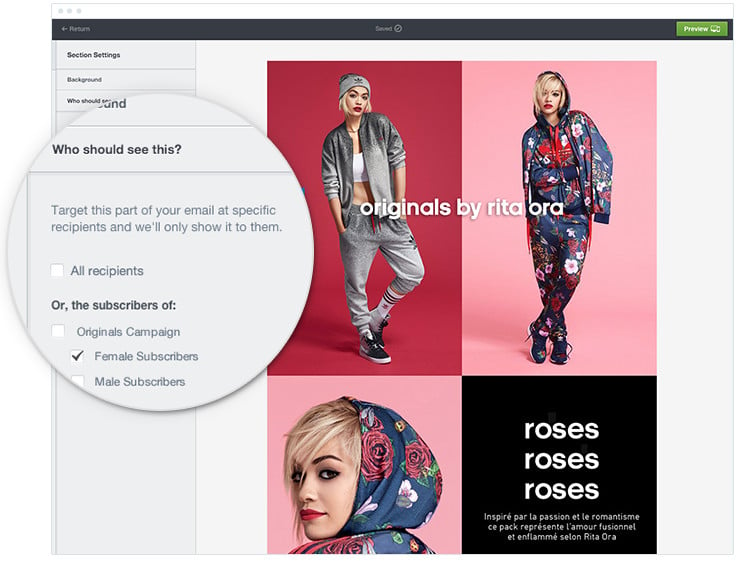
Similarly, you could notice that women love some of your products, while men prefer others.
This fashion brand distinguishes between their female and male followers and serves content accordingly.
This is really the simplest example, and even this goes far towards boosting your ROI.
2. Segment Emails by Behaviour
Email segmentation by behaviour (e.g. usage patterns, past purchases) is a great way to maximize the value of each customer you have. You can use this information to up-sell and cross-sell to them, as well. You can segment by:
Past purchases (value, product types, and categories, etc.)
Sign-up source
Engagement
Benefits and intent
And more!
Actions speak louder than words. And if you segment by actions your prospects take, you’ll be able to tailor offers and maximize your conversion rate.
How to Use Behaviour to Segment Email Audience
For example, if you sell perishables, you could set up refill emails. You could also do what Amazon did, and offer similar and complementary products based on past purchases.
You can also make sure that your email marketing matches the landing page offer.
For example, a lead may have subscribed to your list because they’re interested in a specific product category. If you take note of that, you can immediately follow-up and increase your conversion rate.
Strike while the iron is hot because first impressions matter.
Once your lead signs up, launch a nurturing sequence to engage them. Then, make sure the rest of your email sequences help them advance through the funnel.
Let’s be real: your potential customers abandon their carts for a reason.
It’s a common misconception that people simply “forget” about their carts, or get distracted. There’s usually a very good reason why they choose not to proceed with their purchase.
And in order to create a cart abandonment sequence that reengages, you need to understand why your customers are abandoning their carts:
Do your competitors offer something you don’t?
At which point do your customers abandon their carts?
Which offers successfully reengage your customers?
For example, if your customers abandon their carts on the shipping page, your rates may not work for them.
The follow-up is crucial.
Send the first cart abandonment reminder immediately. Wait a few days, and send another. Finally, send your “hail Mary” offer.
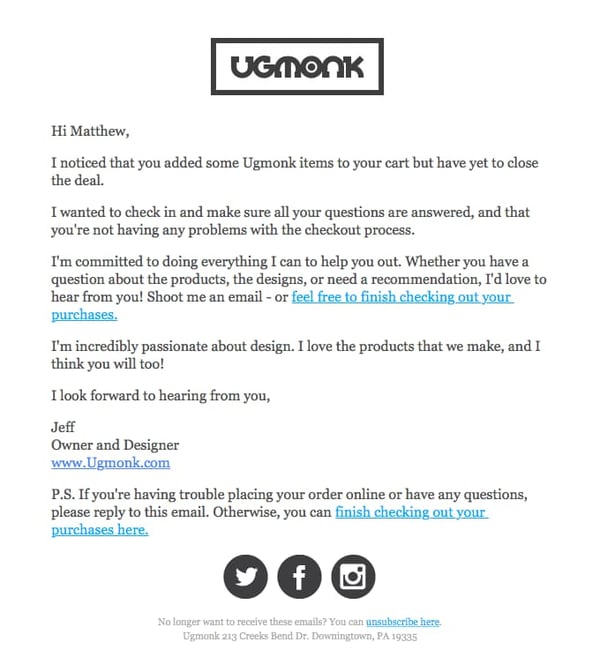
Ugmonk’s example is a great example of a company that understands customers have underlying reasons for abandoning their carts.
If you sell services with lengthier sales cycles, reach out to customers who’ve abandoned their carts and ask them how you can help. This especially goes for B2B.
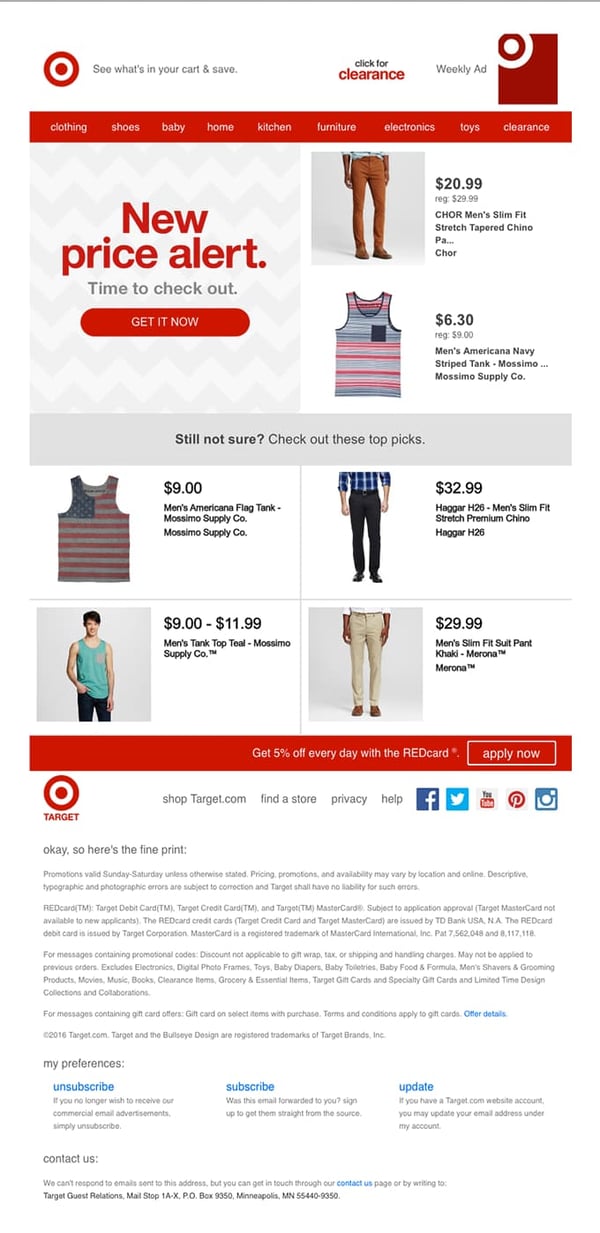
This example is perfect for companies whose customers respond well to price changes and discounts.
Again, this approach may not be the best for B2B companies.
Your prospects might value training more than they’d value discounts. But when you’re in the B2C space, you can’t go wrong with a discount.
5. Email Segmentation for B2B Companies
Even when you’re operating in the B2B space, you’re still talking to individuals. The only difference is: those individuals have higher-ups they need to convince.
You’ll just need to use different segmentation rules to win:
Industry
Job function
Seniority level
Organization type
How to Segment Mailing Lists by B2B Criteria
If possible, establish a detailed lead qualification process.
For example, if you’re using LinkedIn Navigator to reach new leads, you’ll be able to filter by industries and job functions.
If that’s not an option, you can still segment properly.
For example, you can start by asking for general information like name and email address Then, you can send a follow-up email to gather more information and personalize the experience.
Seniority level is also incredibly important.
If you’re communicating with executives, you know that they make the ultimate decision. Content like case studies and benchmark reports will be incredibly useful.
If you’re communicating with people who don’t aren't decision-makers, then you need to help them convince the decision-makers.
AdWeek are pros at communicating with other businesses.
They carefully tailor content according to different interests and niches.
If you subscribe to their newsletter you’ll be directed to a page where you can select the topics you care about.
And speaking of interests...
6. Email Segmentation by Interest
Now, we’ve covered some pretty advanced segmentation strategies.
But if you’re only starting out with email marketing, it can be too much.
You don’t have to establish complex segmentation strategies right away. But you can use one very simple aspect to personalize: interest.
How to Segment by Interest
You can start by tracking email opens.
Segment your subscribers into different lists based on the types of emails they prefer.
Pay attention to content similarities between different emails, especially if you’re selling different products.
The majority of email tools allow you to filter by subscriber behaviour:
Opens
Clicks
Bounces
Unsubscribes
You can use these metrics to create specific segments.
Another way of measuring interest is by evaluating offers subscribers respond best to:
Do they like exclusive products?
Do they buy during sales?
Do they prefer certain brands?
If you notice a lot of VIPs (people who like exclusive products), you can play on exclusivity in your emails. Invite them to be among the first to receive notifications about new products, and so on.
Vitruvi sends specialized product recommendations to customers who’ve shown interest in similar products. This email in particular addresses students and offers a solution that will help them focus.
You can easily gauge this interest type by monitoring leads’ link clicks, and the content they consume.
7. Layered Email Segmentation
Finally, you’ll receive the best returns from your email marketing when your models can accurately represent your customers.
What does that mean?
That means you need a layered email segmentation strategy. It will give you a complete understanding of different audience segments.
We’ve previously talked about segmenting by behaviour, demographic, and other factors. But if you’re ready to take your marketing to the next level, you should segment by all of these factors - and more.
As the image above shows, you can create a segmentation model that consists of different pillars.
You can use demographic data, as well as behavioural, psychographic, and geographic data.
The key is to use every data set relevant to your business.
How to Create a Unique Segmentation Model
If you’ve got a lot of customers and want to significantly increase your revenue, take a look at the data you’re currently collecting.
How are you personalizing your emails?
Which segmentation strategies were successful?
For example, maybe you’ve been segmenting based on opens and past purchases.
If someone frequently clicked on links related to socks and bought socks in the past, then it’s a no-brainer.
Try adding new data points.
For example, geographic data. You might notice differences between people who live in Argentina and Norway. Argentinians will buy socks in July, while Norwegians need warmth in December.
And that’s just the beginning.
The easiest way to get started is by creating customer personas.
When you understand how your customers make purchasing decisions, you’ll be able to leverage the right data.
The folks at Campaign Monitor highlight a great example of using different data points to create personalized experiences.
Our advice for taking such a strategy forward would be putting it into practice. Listing significant milestones is all well and good, but you can do better.
Once you notice a lot of customers sharing the same affinities, you can create entire personalized models; from carefully curated content to benefit-focused offers.